| ::: Evaluation Progress ::: |
|
 |
|
Peer Review Process
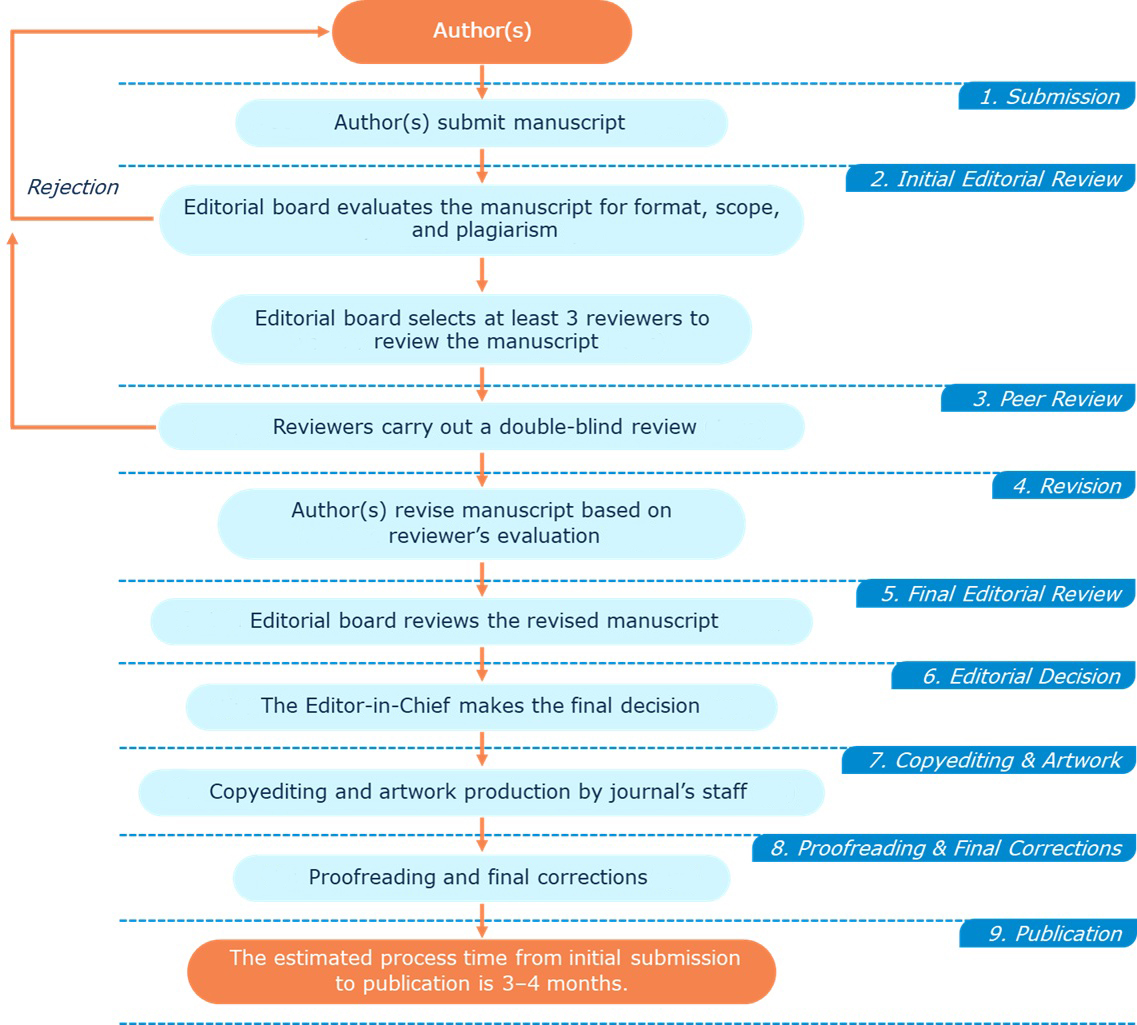
1. Submission
Author(s) are required to submit manuscripts that align with the journal’s aims and scope and are prepared in accordance with the journal's Author Guidelines. All submissions must be made through the system.
2. Initial Editorial Review
The Editor-in-Chief, together with at least two members of the Editorial Board, conducts an initial screening of each submitted manuscript. To proceed beyond this stage, the manuscript must align with the journal’s aims and scope, follow the required format, and demonstrate a Plagiarism Policy of no more than 25%. Manuscripts are also screened for ethical compliance and adherence to academic integrity standards. (Estimated processing time: 7 days).
3. Peer Review
The selected peer reviewers evaluate the manuscript and provide one of the following recommendations:
- Accept without revision
- Accept with minor revisions
- Accept with major revisions
- Reject
Authors are notified of the reviewers’ decisions through the system, including any required revisions prior to publication. The journal employs a double-blind peer review process to ensure fairness, transparency, and academic integrity. (Estimated processing time: 21–30 days).
4. Revision
Authors revise their manuscripts in accordance with the reviewers’ form recommendations. (Estimated processing time: 14–21 days).
5. Final Editorial Review
Manuscripts requiring major revisions are returned to the same peer reviewers for a second round of peer review. (Additional estimated processing time: 14–21 days).
The Editorial Board then evaluates the revised manuscript together with the authors’ responses to the reviewers’ comments. (Estimated processing time: 14–21 days for each manuscript, depending on submission order).
6. Editorial Decision
Following the Editor-in-Chief’s final decision, the author(s) receive an official notification of acceptance, revision, or rejection. Additional information or clarification may be requested at this stage if necessary. (Estimated processing time: 3 days).
If the manuscript does not meet the format requirements, authors will be asked to revise and resubmit their work. In cases of desk rejection, authors may submit a revised manuscript after addressing the identified issues. Manuscripts that pass the pre-screening are then assigned to a minimum of three reviewers with expertise in the relevant field(s) for formal peer review. (Estimated processing time: 14–21 days).
7. Copyediting and Artwork
Received manuscripts will be checked for a maximum similarity score of 20% and then edited by journal staff for final formatting before publication. (Estimated processing time: 7 days).
8. Proofreading and Final Corrections
The formatted manuscript undergoes Proofreading by the journal staff. A draft of the formatted article is also sent to the author(s) for approval. If no further changes are requested, the article is published. (Estimated processing time: 7 days).
9. Publication
Authors are notified once their manuscript has been published. The estimated time from initial submission to publication is approximately 3–4 months.
Publication Ethics and Malpractice Statement for the Peer-Review Process
Al Irsyad: Jurnal Studi Islam is committed to upholding the highest standards of publication ethics and preventing malpractice in the peer-review process. The principles we adhere to are:
-
Confidentiality: The entire review process is confidential. Editors, reviewers, and relevant parties must maintain the confidentiality of all manuscript-related information.
-
Objectivity and Impartiality: Reviews are conducted objectively and without bias. Evaluation is based on scholarly merit, relevance, and quality, free from conflicts of interest. Feedback provided should be constructive.
-
Timeliness: The review process is conducted within a reasonable timeframe. Authors are regularly informed about the status of their manuscript.
-
Transparency and Accountability: The review process must be transparent and accountable. Reviewers are encouraged to provide clear, evidence-based, and constructive comments. Editorial decisions should be fair and based on reviewer feedback and editorial expertise.
-
Conflict of Interest: Editors and reviewers must declare any potential conflicts of interest that could affect their objectivity. If a conflict of interest is identified, steps will be taken to ensure an impartial evaluation.
-
Plagiarism and Misconduct: Editors and reviewers must be vigilant in identifying potential plagiarism, data fabrication, or other research misconduct. Any suspected misconduct must be reported to the relevant authorities.
-
Reviewer Recognition: Al Irsyad: Jurnal Studi Islam values the crucial contribution of peer reviewers. The journal will provide appropriate recognition and appreciation for their dedication to the publication process.
By adhering to these principles, Al Irsyad: Jurnal Studi Islam is dedicated to maintaining the integrity and credibility of the peer-review process, ensuring fairness, transparency, and ethical conduct in manuscript evaluation, thereby upholding the quality and trustworthiness of the published research.